
Press Tool & Sheet Metal Die Design in NX: A Complete Career Roadmap
A practical roadmap to learning press tool and sheet metal die design in Siemens NX — from piercing and blanking to progressive dies, strip layout and cutting-force calculations.
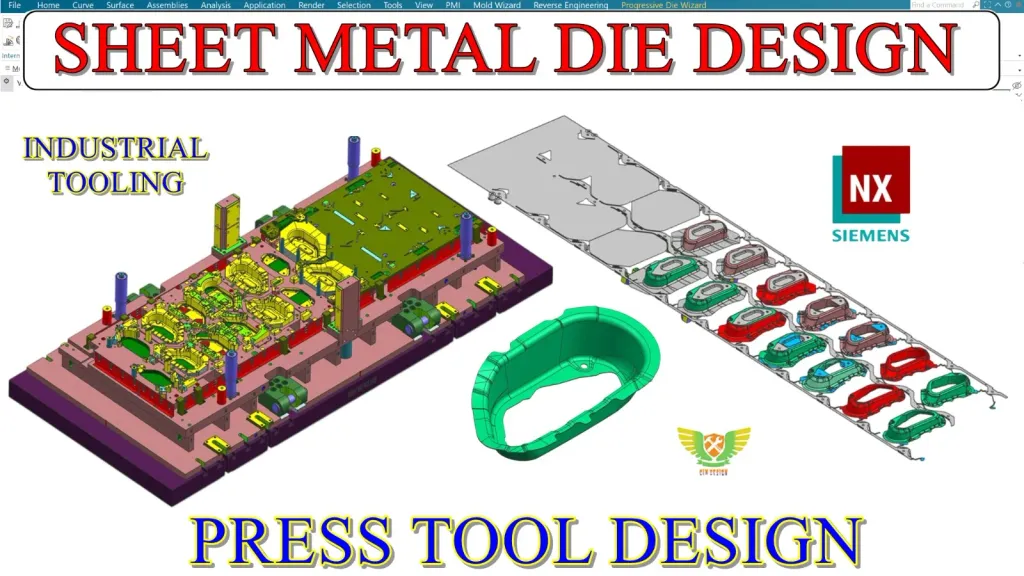
Press tool and sheet metal die design is one of the most reliable, well-paid skills in manufacturing. Every stamped bracket, clip, chassis panel and enclosure begins life as a die — and companies are always short of engineers who can design those dies correctly the first time. This guide walks through what you actually need to learn, and the order that makes it click.
Start with the fundamentals, not the software
Software is a tool; the physics of cutting and forming sheet metal is the real skill. Before you draw a single die plate, you should understand press types, cutting clearance, and the difference between shearing, bending and drawing. A good program grounds you in tool-design theory and product data — punch and die standards, force behaviour, and material properties — so your designs are manufacturable, not just pretty.
Master the single-station tools first
Every complex die is a combination of simple operations. Learn them one at a time:
- Piercing and punching tools — hole-making, clearance, and punch/die construction.
- Blanking dies — separating the blank from the strip with the right cutting force.
- Bending tools — bend allowance, springback, and universal bending methods.
- Drawing tools — cup formation, blank-holder force, and draw ratios.
- Compound tools — combining blanking and piercing in a single stroke.
Working each of these as a full CAD assembly in Siemens NX — with real part files — is what turns theory into job-ready capability.
Move up to progressive dies and strip layout
This is where design engineers earn their salary. A progressive die performs several operations across multiple stations as the strip advances. To design one you need:
- A correct strip layout — station sequencing, carrier and pilot design, scrap web.
- Die base and punch design sized to the press and the strip.
- Both the manual method and the Progressive Wizard workflow in NX, so you can work fast and also debug automated output.
Seeing several progressive case studies — lamp tools, side-cam dies, multi-station layouts — is the fastest way to internalise the decisions.
Don’t skip the calculations
Cutting-force and tonnage calculations decide press selection and tool life. Learn to calculate cutting force for different materials, size your press, and validate that your die will survive production volumes. Electrode design, in-house quotation and BOM preparation round out the skills that make you useful on day one in a toolroom.
Build a portfolio as you learn
The engineers who get hired fastest are the ones who can show completed die assemblies with strip layouts and calculations. Treat every lecture’s project file as a portfolio piece: rebuild it, annotate your decisions, and keep the design intent notes. By the end you should have a folder of progressive, compound and single-station dies you designed yourself.
Where to go next
If you already know Siemens NX modelling, you can jump straight into die design. If not, build a CAD foundation first, then layer die design on top. Either way, focus on real project files and calculations — that combination is exactly what separates a certificate-holder from an employable die designer.
Frequently asked questions
- Do I need prior CAD experience to learn press tool design?
- Basic 3D CAD helps, but our course starts from software and library installation and tool-design fundamentals, so motivated beginners can follow along. If you are new to NX, pair this with a Siemens NX CAD foundation course.
- What kind of jobs can press tool design lead to?
- Tool and die designer, die design engineer, and toolroom design roles across automotive, appliance, and sheet-metal component manufacturing. Progressive die skills are especially in demand.
- Does the course cover progressive dies and strip layout?
- Yes. It covers manual and Progressive Wizard methods, strip layout design, die base and punch design, side-cam dies and multiple real progressive case studies.